Cutting revenue from $36M to less than $10M, and downsizing the team from 45 to 6
Sam Ovens founded Skool with the grand goal of helping 1 billion users find and monetize their passion through online communities.
Before starting Skool, Sam was actually already running a very successful e-learning platform called Consulting.com, selling high-ticket courses to aspiring consultants, which he scaled to $36M a year… from scratch!
(Fun fact: he shelled out somewhere between $300k and $1M for the domain name alone!)
Yet, he decided to throw all of that away in order to pursue a completely new venture.
At a glance, that seems crazy.
In fact, when talking about this seemingly unreasonable early bet, Alex Hormozi, the wildly popular business guru who would later join the company as co-owner, says, "That's where Sam just has these massive balls."
To what extent that's true, I'll let you decide along the way.
But whether blind courage played a factor or not, there's no denying that Sam had a very smart plan.
You see, Sam Ovens wasn't just some off-the-grid hustler. In the late 2010s, he was regarded as the info product guru, and was dubbed "the Henry Ford of consulting" for making consulting, a profession normally available only to the elite, accessible to the masses.

In just about 4 years, his Consulting.com company, scaled from 0 to mid 8-figures, experiencing fantastic growth… but this massive growth came at a cost.
Due to the company scaling so fast, Sam hired 45 people in a very short span, and added a lot of things to the business, like posting on all social channels, many different funnels, many traffic sources, and a bunch of people making up a bunch of teams.
It was a total mess. Operations were chaotic, profit margins were thin, and there were always fires to put out in the company. Sam had to work harder and harder to keep Consulting.com afloat until he eventually got tired of running this kind of hectic business and took a much-needed break to figure out how to restructure his company.
"It felt like I was selling my soul to the content creation machine in order to feed my company and just to pay my expenses… What's the point if I don't enjoy it?"
During the sabbatical, Sam decided to tackle the problems his company had by using the Lean Thinking philosophy — an operating approach that focuses on maximizing value while minimizing waste.
In his case, Sam defined "value" as things that 1) help his clients, 2) get him money, and 3) bring him joy (aka, are fun to do). On the other hand, he defined "waste" as simply everything that couldn't be categorized as value.
"I looked at every part of Consulting.com and tried to define whether it is value or waste. Value is something that improves the customer's experience — it is defined by the customer. Only a few people in my company were customer-facing. 80% of my company was doing something related to paid advertising! Then I analyzed the flows of money. Most of it went into ads. But are ads valuable to the customer? No. And I was like, oh shit, that's pretty bad."
So how did he reorganize things for maximum effect?
To start, Consulting.com didn't generate client results as well as it could have because it was working with too many people. So they stopped working with beginners and focused only on existing business owners to optimize for client results and happiness.
"We dropped our Consulting Accelerator product, and I decided to just focus on existing business owners. We now help coaches, consultants, course creators, and experts achieve $100,000 a month in profit with only one to two products, two to three remote staff, happy clients, and happy founders."
However, this new modus operandi demanded drastic changes.
Sam shrunk the team from 45 to 6. He eliminated almost all of their traffic sources (Instagram, Facebook, etc.).
They even stopped running ads, on which they used to spend between $30k and $40k every day.
"So I basically got rid of 80% of the company, cut paid advertising to 0, and had a small team of 4-5 people that were all touching the customer, and we found a way to get the customer organically just by running really good programs, getting people really good results, and sharing that as our content strategy."
After substantial cuts, the company now had only 2 offers, 1 funnel, and 2 traffic sources (YouTube and email newsletter).
The result? Despite revenue falling by more than 70%, Consulting.com was way more profitable. In one of the following months, they made $800,000, with $60,000 in expenses — the rest was pure profit.
So… happy days, right?
Not exactly.
A company like Consulting.com (that sells courses and helps people on the internet) needs three core components to function:
- A content portal, or an LMS (learning management system),
- A community where students interact, comment, help, and meet each other,
- Scheduled live Q&A calls for coaching, so students can show up and ask questions.
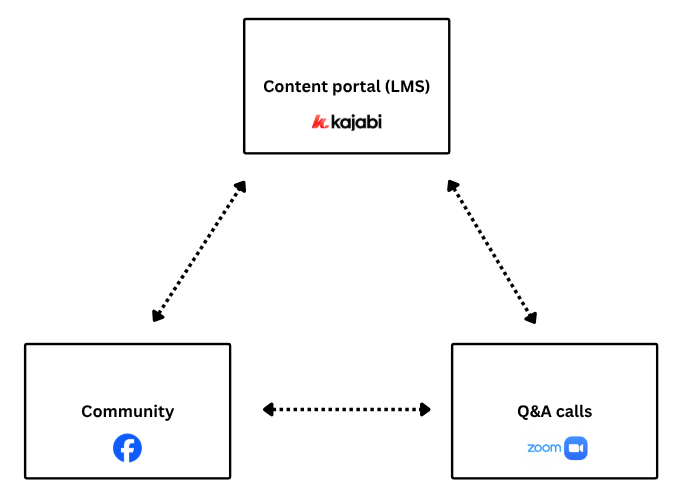
In Sam's case, he was using Kajabi for LMS, Facebook Groups for community, and Zoom for Q&A calls. But trying to get all of these things to work together was super annoying because they were completely separate, different things.
The students had to log in to Kajabi to watch the course. They had to log into Facebook to hang out with other students (while trying not to get distracted by cat videos and other interruptions that pop up all the time on Facebook). And trying to get people from all over the world in different time zones coordinated for Q&A calls was also a problem.
If you think about it, this fragmentation is considered a "waste" through the lens of Lean Thinking. Sam had to come up with a solution to reshape it into "value".
It was an issue that needed to be addressed, but there weren't any tools that took care of this.
"I'm experiencing this problem, and it kind of sucks. I can see the solution in my head. Screw it, I'm just going to build a company and solve my own problem."
And solve his own problem he did. He built a platform that served as an LMS, a community, and a calendar with live Q&A calls all in one. He named it Skool and became his own client with Consulting.com.

"It basically takes these three major pieces: your course & content portal, your community, and your event schedule, and it puts them into one simple tool that your students can access with one login and one unified search."
But as soon as Sam started Skool, a different problem popped up: his attention was simply split too much between the two companies.
Sam had to make a sacrifice.
The high-stakes gamble: Getting rid of the highly profitable Consulting.com to go all in on Skool, bleeding over $300,000 per month
In 2023, Sam pulled the trigger. He sold Consulting.com, refunded his mastermind called Quantum, and cancelled his podcast after just 3 episodes.
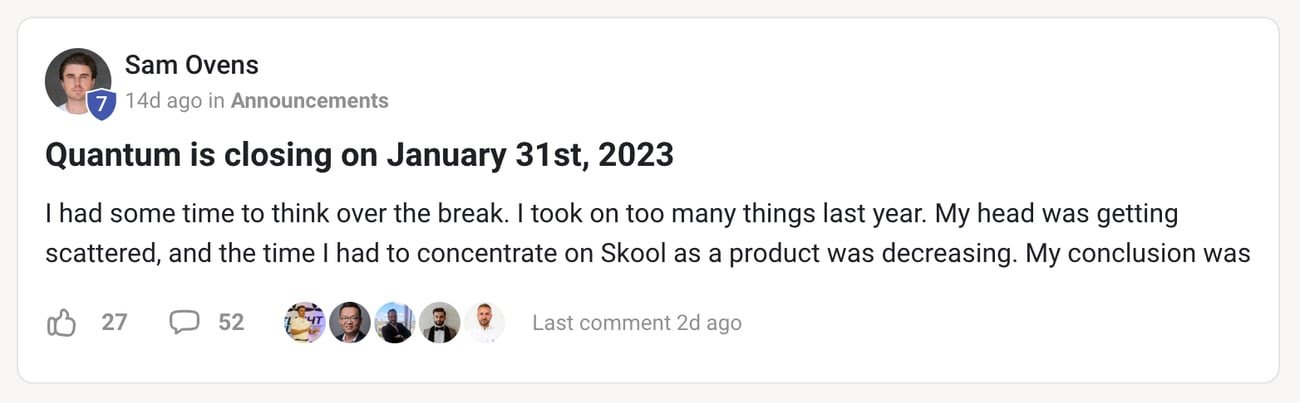
What drove him to such extreme decisions? Here's the logic he followed:
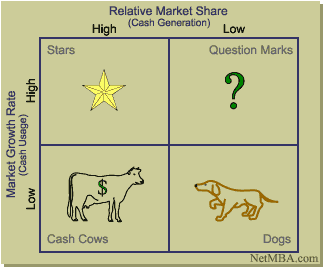
During the period when Sam hired 45 people to work on Consulting.com, the company was a Star — generating a lot of cash but also using a lot of it.
This is when Sam got really frustrated with the business and decided to make radical changes. To make it simultaneously more fun for him and more profitable, he moved Consulting.com to be a Cash Cow — cut a lot of costs, made it very cash-efficient, while still bringing in quite a lot of revenue.
Cash Cows are very good for funding Question Marks, and he did just that.
He started Skool with the resources from his Cash Cow (Consulting.com), which was funding Skool for 3.5 years.
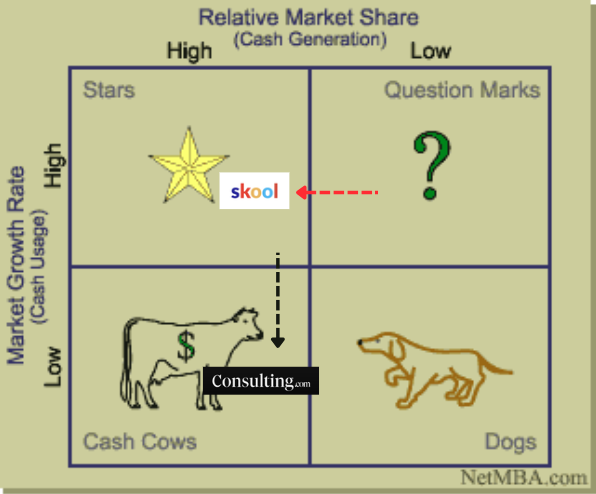
Over that period of time, Sam managed to move Skool into the Star position. But now, a new hurdle arose: both a Star and a Cash Cow by themselves demand a significant time investment. Having both at the same time is problematic because it splits your focus.
This put a lot of stress and pressure on Sam, which led him to sell Consulting.com to concentrate his focus and energy for maximum progress.
That's why he also refunded his Quantum mastermind and cancelled his podcast (although he also just didn't enjoy doing the latter) — he needed to focus.
Even when he wasn't actively engaged in his "side-quests", his mind was thinking about them nonetheless. It was little thoughts that popped up out of nowhere to eat away at his attention: "I could have asked this," "Next time, I should pre-frame the conversation in this way", "The camera should be moved that way", etc.
This decision was nowhere near a no-brainer, however.
Skool was still losing money at the time, about $300,000 a month, with some months as high as $700,000. Up to that point, Sam's Quantum mastermind was about covering it.
And when he cancelled it, not only did he lose that cover, but he also had to refund over $1M to people who had already paid in advance.
But if his mind wasn't thinking about the product (Skool), then he was distracted, and everything that distracted him got cut:
"Those are the kind of choices that are the most challenging, but also most often lead to a breakthrough. I did the math and figured out how fast I can bridge this gap if I focus on it fully, and it turned out to be a great choice."
Sam also adds: "Balls and math. You need a little bit of both."
His plan moving forward was clear: channel every ounce of focus into Skool and improve product quality as much as possible by going through the following steps:
- Focus on the community and engaging with people,
- Gather feedback from users,
- Improve the product based on that data, and
- Repeat.
"This will create value for the community, which will hopefully make the users love it so much that they will tell their friends, and that's how Skool will grow."