
In Part 1, you learned how Sam recognized the market opportunity and reorganized his businesses to take advantage of it as best he could.
In this short essay (Part 2), you will learn how Sam went about building Skool for growth.
Enjoy.
The first critical decision that determined whether Skool would be a success or a failure: Partnering with the right co-founder
Sam's business goal for Skool is to onboard 1 billion users.
Now, how did he go about laying the foundation for what would become an absolute behemoth of a company? Where did he start to ensure Skool had the right infrastructure set in place to blast off?
In the founder's own words:
"For Skool to be successful, it's basically a social network, and our main competitor would be Facebook Groups. Facebook has amazing engineers and a lot of money. However, I'm not a software engineer. If I want to have a chance of succeeding, I would need to have a technical co-founder who was as committed and as hardworking as I was, and that's basically Mark Zuckerberg in terms of technical expertise and software engineering. And I figured if I don't have that person, I might as well not try because I won't succeed."
[Note: The point above is less obvious than it seems. In fact, this is where Alex Hormozi, the business guru who would become Skool's co-owner in 2024, tripped up with his company ALAN, an automated lead nurture software. Every business consists of 1) Acquisition, 2) Operations, and 3) Product. He had the first two down because he knew how to get customers and build the team, but the last one eluded him. He isn't a code guy and didn't have a technical co-founder. He had to outsource development and blind negotiate, putting him at a severe disadvantage.]
Understanding the gravity of finding the right co-founder, Sam spent a year looking for the appropriate person. He conducted 600 interviews and hired 5 people just for recruiting. For an entire year, this was pretty much all he did.
"The entire process sucked, but I just kept telling myself, 'You will never succeed if you don't have this one person. There's no getting around it: this is step one.'"
The technical co-founder Sam recruited was Daniel Kang.
And together, they built a flywheel right into the platform itself.
The growth loop that enabled Skool to build the best product on the market
There's a saying in software engineering: "You can make something so complex as to hide the problem, or so simple that the problem is exposed."
Sam takes that kind of approach to everything he does:
"If I can't sell this with a Loom and a Google Doc, then I shouldn't be selling. Because the core mechanics of the offer should lift the weight on their own. If it doesn't make sense like that, then everything else I'm doing is just trying to put lipstick on it."
So, how did he launch Skool?
He did a private beta. He is a firm believer that you can't ever make a product good enough to just launch publicly and immediately start charging money for it.
And that's because people need to use the product first. They will use it in ways you didn't even think of and surface different bugs you have to fix.
Sam uses this approach for courses as well as masterminds.
First, he comes up with a proof of concept. Then he shares it with people and tries to recruit a private beta or a beta group.
That gets him a particular segment of the market that's willing to be the guinea pig — they want to go first, they want to be the early adopter, and they're willing to tolerate things not quite figured out.
He gets them in and then he co-creates the product with them, always keeping his finger on the market's pulse.
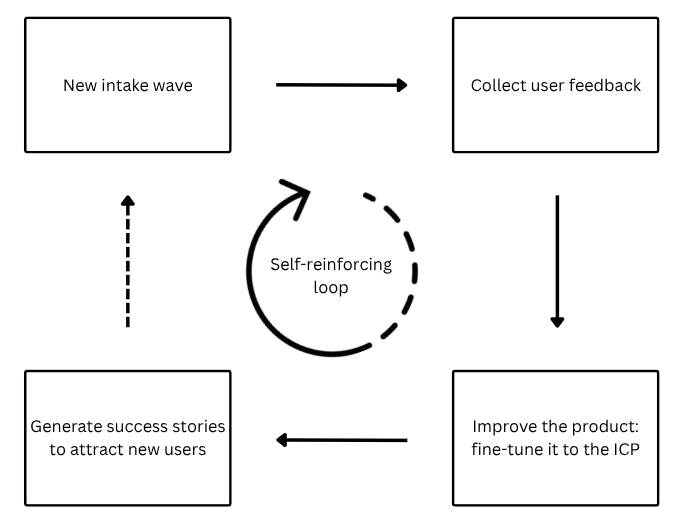
And once the first success stories start rolling in, he can reverse-engineer those by talking to the users who succeeded. These are simple questions that let him fine-tune the product to his ICP even more:
- "What were the things that threw you off?"
- "What were the things you focused on more than the others?" etc.
Then he can do another intake wave or cohort because he can market for it by using the success stories from the beta group. He brings that wave in, makes sure everyone is happy, collects the success stories, and then takes the next group in.
To get the snowball to compound from the start, you need the right scoping: who is it for, what is the goal, and what are the criteria to be a member.
Without those, your user feedback won't be great, your product won't be optimized for the ICP, your success stories won't be impressive, and the compound effect you'll try to get rolling will be pretty much nonexistent.
But when you get scoping right, then it's just recruiting those people, getting them in, and checking them at the gates to make sure they fit the criteria.
Take it from the founder himself: "You get the right people in, and then it just happens."